To Hell and Back: The 200-mile Underground Ultra
Updated: Jun 14, 2025
Published in Ultrarunning Magazine, June 2025. (Pages posted with permission). Text below.

Buried deep, 300ft below the well-mown lawns and cricket squares of sleepy Somerset village Combe Down, lies a tunnel almost exactly one mile long. Pedestrians have passed through its soot-black walls since its public reopening in 2013, nearly 50 years after the last train rolled out.
At 3.30pm on Friday 28 February, 34 runners entered the tunnel’s southern portal, sharing little but a certain collective masochism. When they reached sunlight at the north end, they did not follow walkers continuing the four-mile trail towards Bath. Instead, they turned back, planning to fully resurface two days and 200 miles later.
Dubbed “the most claustrophobic race on earth”, The Tunnel Ultra is a mind-bending ultra-marathon with a completion rate of around 15 per cent. Runners are tasked to finish 100 out-and-back laps of the UK’s longest foot tunnel in a tight 55 hours.
This year, for the first time in the event’s history, The Tunnel had a female winner. Alex Marshall, a 33-year-old personal trainer from Cambridgeshire, dominated the race, winning by over six-and-a-half hours.
Finally still, in Sunday morning’s icy air, Marshall’s body began to seize. Another runner untied her shoes. Two more propped her up as she walked stiffly towards a heated van. Marshall, now delirious, had broken the course record by nearly two hours.

Gender and ultrarunning
In ultrarunning, the performance gap between men and women is narrowed. An analysis of more than 5 million ultra-marathon results revealed that female runners generally average faster times in distances over 195 miles, attributed to a combination of physiology and strategy.
“In an ultra-marathon race, it’s not just down to physically being fit. It’s mainly about the strategy, because if you’re going off too quick you burn out,” said Marshall. “A lot of the men sprinted off and then slowed right down at the end, and I just kept my own steady pace”.
“I think what gets women more so through it is sticking to their own goals and mentality, whereas men, it’s more ego that drives them,” she said.
Despite results, just two of The Tunnel’s 23 previous finishers have been women. Until this year, the female course record was almost seven hours slower than the male. “Ultrarunning in general is about 80 per cent male over around 100 miles. I have very few females in my events. Maybe a handful each time,” said race director Mark Cockbain.
Kendra Wedgwood, 44, a North Yorkshire detective inspector, joined Marshall and seven other women on the start line. She said being a mother makes training harder – “it is different, you know, having a child, as a mum, and having the time”.
“I’m really lucky,” said Wedgwood, who has a seven-year-old son with husband Martin. “If you’re a single parent, you can’t go out running at 5am because there’s nobody in your house looking after your children.”
After quitting halfway two years ago, Wedgwood returned to prove her strength. Her biggest motivation? A desire never to come back.
“The Tunnel was the first time I'd ever quit at anything and so I had to go back. I said if I didn't finish it this time, I would go back again”, she said. “More than anything I knew I did not want to go back.”

Running The Tunnel
The Tunnel, first held in 2019, is a race designed to break. No headphones. No running side-by-side. No outside support. Any pleasure is found and quickly removed.
2024 winner David Bone, 53, called Cockbain a “sadomasochist” – “If he hears a rumour that someone might be enjoying one of his events, he’ll put a rule in place to remove that enjoyment”.
“I don’t want there to be no finishers,” Cockbain told the BBC in 2023, “but I do want them to go through hell to get there.”
For Cockbain, 52, ultrarunning is “an addiction”. He had run more than 100 ultra-marathons by the time a chronic knee injury forced him to stop running completely. Instead of abandoning his addiction altogether, he set about designing some of the world’s most extreme races.
In The Line 300, runners are entirely unsupported, given 6 days to track a 330-mile portion of the Greenwich Meridian Trail. The Hill Ultra tasks participants to run 160 miles up and down a Shropshire hill, a total elevation comparable to summiting Mount Everest from base camp four times over.
Globally, The Tunnel is Cockbain’s most notorious race. This year Stephen Redfern, 53, flew 20 hours from Sydney to run. He left halfway. Cockbain, however, wants The Tunnel to remain small. Limited media access is permitted and very few spectate. When runners finish, they are greeted by a few sporadic claps, a handshake from Cockbain and whatever camping chair they brought.
This year, official setup consisted of a timing mat at each entrance, a trestle table holding water and protein bars, a biohazardous Portaloo inside a large puddle and a small green gazebo fitted with a tea kettle 20 metres beyond the tunnel’s south entrance.

Origin stories
Marshall started ultrarunning “accidentally”. She became hooked after running a 5km Race for Life with her mum, aged 11. She later transferred to longer road races and, eventually, marathons. “It just got to a point where I was doing a silly amount of miles,” she said. “I was doing [ultra-marathons] in training without actually knowing what it was.”
Running quickly became a survival tool, “I've struggled with my mental health since I was 16 and the main reason why I keep doing ultrarunning is to overcome mental health,” Marshall said. “I would like to kind of switch off and just run and just process stuff in my head, and the longer I ran, the more my head felt much better.”
Every day she wakes at 3.30am to fit training around client sessions. She came to The Tunnel to break the record: 43hr 6min set by Guy Bettison in 2020 – “I’m flying the flag for the ladies”.
A levelled playing field
Marshall’s victory is not the first of its kind. In the first edition of Utah’s Moab 240 in 2017, Ultrarunning legend Courtney Dauwalter beat first-place male by 10 hours. In 2019, Jasmin Paris became the first woman to winthe 268-mile Montane Spine Race, shattering the course record by nearly 12 hours while pumping breast milk at aid stations.
The more suffering involved, the more level the playing field. Research shows that female runners experience less muscular fatigue over long distances partly because females have a higher proportion of type I (slow-twitch) muscle fibres. More efficient oxidative metabolism (using carbohydrates and fats as fuel) provides sustained energy for endurance, while smarter pacing strategy and mental toughness mean women regularly compete better in ultra-marathons.
But fields are still often overwhelmingly male. Only a quarter of this year’s The Tunnel starting lineup were women. “Women generally don’t enter events unless they really, really think they can finish them, whereas men tend to just enter,” Wedgwood said. “I only enter events now which I’m unlikely to finish.”
Marshall hopes her record-breaking run will motivate “more women to want to enter because they've seen a woman has now got the record.”
No distractions
Ultra-marathons commonly pair long distances with variable terrain in scenic landscapes: Marathon des Sables runs through the Sahara Desert, while “Britain’s most brutal endurance race”, the Montane Spine Race, spans the Pennine Way’s entire craggy length.
The Tunnel, in contrast, provides no variety beyond slight bends and divots. With little to pull focus, participants fixate on small details. To much agreement, one runner bemoaned that the “hill”, a hardly perceptible rise in the tunnel’s centre, was getting “harder and harder”.
At 192 miles, with little to distract her from the looming time cutoff, Wedgwood was given a gift: a painful blister. “I remember feeling really grateful for getting this really sore blister,” she said, “because it was taking the attention away from my ankle.”
“I remember thinking on lap – when I had three laps to go – ‘right, I hope the blister pops now, so that’s a new pain to distract me for the next lap.’”
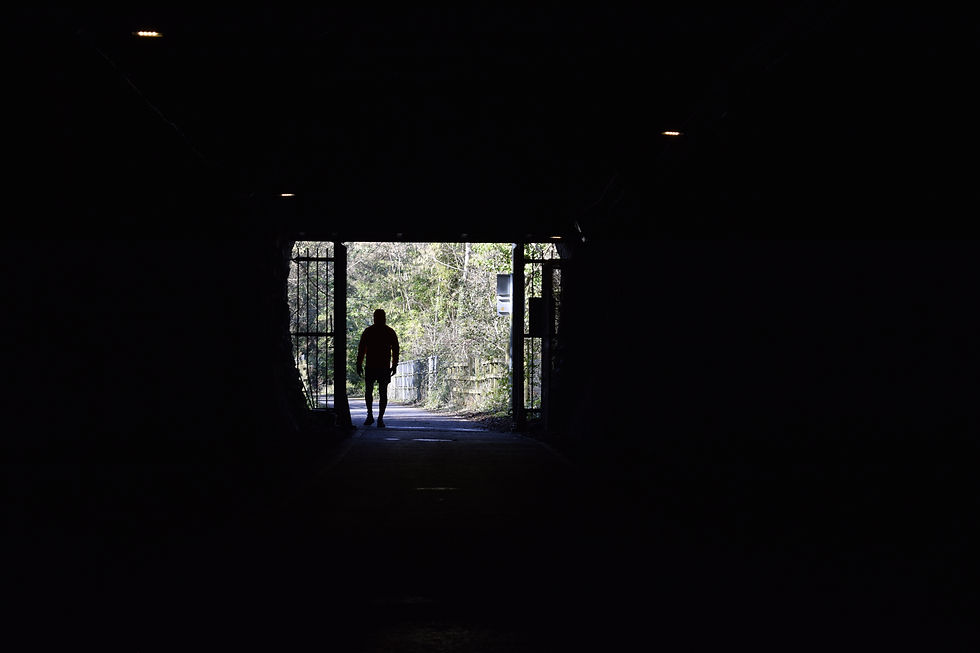
“Don’t stare at the sides unless you want to fill your head with death”
The tunnel’s dim lights turn off at 11pm to protect the bat colonies inside. Runners continue with only head torches. Dull footsteps and dripping water remain to indicate surroundings until the lights return six hours later.
Bone said the worst part of last year’s race was the thought of night two – “You all have this shared night one experience, and everything that happens you turn into a positive.”
“In the day, you were prepping yourself for a horror, which is why a lot of people pulled out,” he said, “you realise that actually when it went pitch black, however silly it is, you couldn’t see what you were doing, it wasn’t nice, you slowed your pace down, it took longer, it got colder.”
The Combe Down tunnel was once notorious for phantom train noises that continued long after its railway closure. Amid darkness and delirium, faces form in the rock wall. “When you’re running you just don’t stare at the sides unless you want to fill your head with death,” said Bone. Most reported full-blown hallucinations.
Vanessa Kellie, 47, found herself at a deli counter. Marshall remembered giraffes, heads through sunroofs, driving cars down the tarmac. Wedgwood repeatedly met a giant cat sitting halfway down the tunnel.
“He had his back to me, so when I started running up I was thinking, ‘oh gosh, I can’t go through him’,” she said, “so I was trynna crawl around the edge of the tunnel so I didn’t go through him.” Eventually she resolved to run straight through, “I thought ‘well, if I hurt him he’ll tell me’”.
Tunnel-visioned
Most entrants are resolutely singular in focus. American Bart Schuster, 54, flew from Virginia to race The Tunnel. He said there was “zero” chance he wouldn’t finish, “if I have to crawl my bloody body across the finish line, it’s going to get across the finish line.”
He later lowered his assessment to 98 per cent, “I have to leave some uncertainty to who knows what”. Entering night two Schuster was on schedule to finish, fast. But as the ground froze, his pace slowed. With 16 hours left to run his last 32 miles, he quit, citing extreme cold.
Grant Grego, 32, who managed 88 miles, started running seriously in 2021. “You’ll find a lot of ultrarunners are fucked up, they’ve had either past trauma [or are] going through trauma. For me, it’s a form of expression,” he said, “I spent years being bullied by various people”.
To Grego, running proves resilience. “You spent so many years suffering at the hands of others and you didn’t quit – what can you achieve by suffering at your own hands?”
Sometimes such singular focus impacts life beyond running. Daniel del Piccolo, 47, left this year’s race after 54 miles. He said his friends and family don’t understand The Tunnel, “they think I’m fucking crazy.”
After lasting 145 miles in 2021, Piccolo returned to test his grit. “These days there’s so much emphasis on comfort,” he said. “When you finish a race, especially like The Tunnel, you get to enjoy your comforts so much more”.
Now in the “tail-end” of a divorce, Piccolo said ultra-marathon training hurt his marriage because “it just requires so much time”. “I remember being out on many runs feeling that pressure of not being at home and you can almost feel things boiling,” he said, “it definitely strained it.”
“All I have to do is run up and down a tunnel”
Others take a different approach. Elizabeth Hilton, 57, cares for her 28-year-old daughter with special needs. She entered The Tunnel to set an example, “because often you don't get that many women doing these distances and you certainly don't get that many middle-aged, not particularly quick, you know, typical athletic type women doing it.”
“I feel like the difficult bit is sorting everything out to go,” she said before the race, “and when I’ll come back and my daughter will expect me to be straight back into things”.
“Once I’ve gone, all I have to do is run up and down a tunnel”.
Hilton lasted 92 miles. She said male and female ultrarunners often approach races very differently. “I have noticed on just a quick glance at Facebook that the narrative from most of the male runners is very, ‘this is brutal, it will turn your head inside out,’ and the women who posted mostly said ‘I’m really excited!’”
The Tunnel freezes
By midnight on Saturday, as The Tunnel entered its third day, less than half remained. The south entrance, once flanked by regimented lines of camping chairs, kit bags and foil blankets, now resembled Monday morning after a particularly sorry festival.
“When you see more and more people going, people that have conquered massive ultra-marathon distances and all sorts, you're kind of thinking, ‘well, if they're going, am I able to do this?’” Marshall said.
On Sunday, temperatures dropped below freezing. The Combe Down tunnel offers little protection from the cold. “It just felt like an ice zone”, Marshall said, “a twilight zone. That’s when my head started to go.”
Wedgwood ran wearing a floor-length dry robe her husband made her take – “I’ve never experienced cold like that,” she said. “If I didn't have that dry robe, I'm quite confident I would have had to pull out.” A handwritten note was taped to her bag that said, “Remember how much you want it. Don’t let anyone get in your head.”
Painful victories and painful failures
Marshall finished the tunnel on Sunday morning after 41hr 16min, breaking the previous record by 1hr 49min. On the line, she appeared totally unaffected. She smiled, like she had all race, shook Cockbain’s hand and politely asked the few gathered spectators how they were. “My head was actually gone”, she said. “My body was very wobbly, and I was too busy trying to keep myself upright and thinking about what was in my head until I sat down and just allowed myself to just be like, ‘wow’.”
“I cannot see this time being beaten for a very long time”, said Cockbain, calling Marshall’s performance “phenomenal”.
“She was the talk of the tunnel,” Wedgwood said. “Every time I'd see her red pants coming up, I just kept thinking, ‘oh, that's our girl, here she comes’.”
Over the last decade, ultrarunning has exploded in popularity. Yearly participation has reportedly grown 345 per cent since 2010. But, with great successes come many more painful failures.
For most of his life, Giacomo Squintani, 49, hated running – “I could not comprehend why anyone would sacrifice valuable time to just go run along a road”. Since October 2012 Squintani has run at least one continuous mile every day, “I underwent epilepsy surgery in November 2011 and to this day I maintain that they took out the piece of my brain that hated running”.
When asked if he has siblings, his answer is complicated: “My elder brother was stillborn, then there was me, and my younger brother died within hours of being born”.
“There are two people I think about before the start of any race I do,” Squintani said. “I’m alive, and I’ve got the chance to do this and I will honour that chance for me and for those who do not enjoy that chance”.
Last year, Squintani entered another Cockbain event, The Bridge: 100 two-mile crossings of the Old Severn Bridge, connecting Gloucestershire to south Wales. With plenty of time to run the last eight miles, Squintani unravelled, “I started seeing things in the River [Severn] that I knew are not there”.
Squintani “DNFed” (did not finish), becoming a reluctant legend in the ultrarunning community. He came to The Tunnel to right that wrong, but instead, history cruelly repeated itself.
With 2hr 30min to run four final miles, it happened again. Squintani DNFed, this time at 196 miles. One runner remembered passing him leant against the limestone, looking for the entrance – “I thought, ‘I’m no longer in the tunnel, where am I?’”
Squintani’s wife came to watch him finish. She was sent inside to bring him out of the tunnel. “Was I so concerned that it would happen again that it became a self-fulfilling prophecy?” Squintani said.
Ironically, because the Combe Down tunnel measures 62 metres more than a mile, Squintani had actually run 200 miles. But the DNF still stood. At home, his 17-year-old son helped him climb the stairs. The next day, Squintani got up and ran his daily mile. A week later, asked whether he might consider attempting The Tunnel again someday, he replied without pause – “my entry was in yesterday”.
“I didn’t think you were gonna do it, girl”
Wedgwood was three miles behind when Squintani left on Sunday evening. Earlier that morning, with nearly two marathons to run, she made herself a hot tea in the small gazebo to steel herself for the day ahead – “I remember walking out thinking, ‘right, I’m just running now until the end, with no breaks’”.
Just 20 minutes before cutoff, Wedgwood finished, hugging her son on the line. “I didn’t think you were gonna do it, girl,” her husband said.
Wedgwood was the last of seven finishers. “It’s quite cool,” she said, “you’ve got Alex breaking the record and me, winging it, right on the wire, and everyone thinking I’m gonna fail and then just scraping through.”
“The Tunnel is the hardest thing I’ve ever done, I think it’s probably the hardest thing I will ever do,” she said.
Ultrarunners often experience the infamous “post-race blues”, a situational depression that descends in the wake of a big event. The next day Wedgwood said she felt “deflated, no emotion”. “I haven’t felt proud yet”, she said, “but it’s coming”.
To Marshall, there is only one ever effective solution: “You book another race”.


Comments